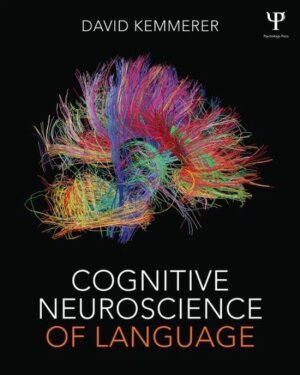
Cognitive neuroscience of language
David Kemmerer
Staat:
Gebruikt
Studierichtingen:
Bachelor of Science in de psychologie (Vrije Universiteit Brussel), Master of Arts in de taalkunde (Katholieke Universiteit Leuven), Bachelor of Arts in de toegepaste taalkunde (Katholieke Universiteit Leuven), Master of Science in Biomedical Sciences (Universiteit Antwerpen), Bachelor of Arts in de toegepaste taalkunde (Universiteit Antwerpen), Bachelor of Arts in de taal- en letterkunde (Universiteit Antwerpen), Master of Arts in Linguistics and Literary Studies (Vrije Universiteit Brussel), Master of Arts in de taal- en letterkunde (Vrije Universiteit Brussel), Bachelor of Arts in de taal- en letterkunde (Vrije Universiteit Brussel), Bachelor of Arts in de taal- en letterkunde: combinatie van twee talen te kiezen uit de Germaanse talen (Katholieke Universiteit Leuven), Bachelor of Arts in de taal- en letterkunde: combinatie van twee talen te kiezen uit de Romaanse talen of de Germaanse talen (Katholieke Universiteit Leuven), Master of Science in de logopedische en audiologische wetenschappen (Katholieke Universiteit Leuven), Master of Science in de psychologie (Katholieke Universiteit Leuven), Master of Science in Digital Humanities (Katholieke Universiteit Leuven)
ISBN:
9781848726215
Toegevoegd op:
19 januari 2022
Beschrijving
Compleet overzicht met theoretische en praktische inzichten over taalverwerking. Helder geschreven en makkelijk te volgen. Geschikt voor wie interesse heeft in logopedie, neurolinguïstiek, psycholinguïstiek, neuropsychologie, klinische taalkunde, etc. Originele prijs: 80 euro Language is one of our most precious and uniquely human capacities, so it is not surprising that research on its neural substrates has been advancing quite rapidly in recent years. Until now, however, there has not been a single introductory textbook that focuses specifically on this topic. Cognitive Neuroscience of Language fills that gap by providing an up-to-date, wide-ranging, and pedagogically practical survey of the most important developments in the field. It guides students through all of the major areas of investigation, beginning with fundamental aspects of brain structure and function, and then proceeding to cover aphasia syndromes, the perception and production of speech, the processing of language in written and signed modalities, the meanings of words, and the formulation and comprehension of complex expressions, including grammatically inflected words, complete sentences, and entire stories. Drawing heavily on prominent theoretical models, the core chapters illustrate how such frameworks are supported, and sometimes challenged, by experiments employing diverse brain mapping techniques. Although much of the content is inherently challenging and intended primarily for graduate or upper-level undergraduate students, it requires no previous knowledge of either neuroscience or linguistics, defining technical terms and explaining important principles from both disciplines along the way.
Contacteer Karen Meersmans
Log in om Karen Meersmans te kunnen contacteren.
Inloggen