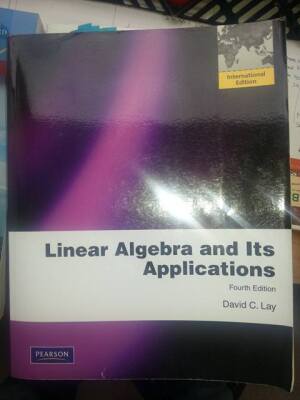
Linear Algebra and Its Applications (Fourth Edition)
David C. Lay
Staat:
Gebruikt
Studierichtingen:
Bachelor of Science in de bio-ingenieurswetenschappen (Katholieke Universiteit Leuven), Bachelor of Science in de biologie (Vrije Universiteit Brussel), Bachelor of Science in de biologie (Universiteit Gent), Bachelor of Science in de biologie (Katholieke Universiteit Leuven), Bachelor of Science in de chemie (Vrije Universiteit Brussel), Bachelor of Science in de computerwetenschappen (Vrije Universiteit Brussel), Bachelor in de elektromechanica (Katholieke Hogeschool Vives Noord), Bachelor of Science in de geneeskunde (Katholieke Universiteit Leuven), Bachelor in de bouw (Katholieke Hogeschool Vives Noord), Bachelor of Science in de informatica (Katholieke Universiteit Leuven), Bachelor of Science in de ingenieurswetenschappen: architectuur (Katholieke Universiteit Leuven), Bachelor in het onderwijs: kleuteronderwijs (UC Limburg), Bachelor in de elektromechanica (Odisee), Bachelor of Science in de toegepaste economische wetenschappen: handelsingenieur (Universiteit Antwerpen), Bachelor of Science in de fysica en de sterrenkunde (Vrije Universiteit Brussel), Bachelor of Science in de toegepaste economische wetenschappen: handelsingenieur (Katholieke Universiteit Leuven), Master of Science in de ingenieurswetenschappen: biomedische technologie (Katholieke Universiteit Leuven), Master of Science in de ingenieurswetenschappen: bouwkunde (Katholieke Universiteit Leuven), Master of Science in de ingenieurswetenschappen: chemische technologie (Katholieke Universiteit Leuven), Master of Science in de ingenieurswetenschappen: computerwetenschappen (Katholieke Universiteit Leuven), Master of Science in de ingenieurswetenschappen: elektrotechniek (Katholieke Universiteit Leuven), Master of Science in de ingenieurswetenschappen: energie (Katholieke Universiteit Leuven), Master of Science in de ingenieurswetenschappen: materiaalkunde (Katholieke Universiteit Leuven), Master of Science in de ingenieurswetenschappen: werktuigkunde (Katholieke Universiteit Leuven), Master of Science in de toegepaste informatica (Katholieke Universiteit Leuven)
ISBN:
9780321623355
Toegevoegd op:
30 september 2015
Beschrijving
Linear algebra is relatively easy for students during the early stages of the course, when the material is presented in a familiar, concrete setting. But when abstract concepts are introduced, students often hit a brick wall. Instructors seem to agree that certain concepts (such as linear independence, spanning, subspace, vector space, and linear transformations), are not easily understood, and require time to assimilate. Since they are fundamental to the study of linear algebra, students' understanding of these concepts is vital to their mastery of the subject. David Lay introduces these concepts early in a familiar, concrete Rn setting, develops them gradually, and returns to them again and again throughout the text so that when discussed in the abstract, these concepts are more accessible.
Contacteer Roberto
Log in om Roberto te kunnen contacteren.
Inloggen